





Most trustees start a trust to serve a cause, not to do bookkeeping. But when the auditor arrives, or a donor asks for a statement, messy records become a real problem. The good news is that maintaining the books of accounts for a charitable trust is not complicated once you build a few habits.
Quick answer: Under the Maharashtra Public Trusts Act, every trustee must keep regular accounts. That means a proper cash book, bank records, vouchers, and yearly financial statements that your auditor can verify.
Why trust accounts matter
Your accounts prove that money collected for charity was used for charity. They also protect trustees personally, support your 12A and 80G status, and make the annual trust audit much faster.
The records every trust should keep
- Cash book and bank book: Record every receipt and payment on the day it happens.
- Vouchers and bills: Keep a receipt or bill for every expense, with a short note on the purpose.
- Donation receipts: Number them in sequence and record the donor’s name and PAN where available.
- Ledger: Group entries under heads such as donations, grants, salaries, programme costs and administration.
- Fixed asset register: List every property and valuable asset the trust owns.
- Minute book: Record trustee meetings and decisions, especially on spending and investments.
Treat corpus and general donations differently
A corpus donation is meant to be kept as the trust’s permanent capital, so it should go to the corpus fund in the balance sheet and not be spent as income. A general donation can be used for activities. Many errors in donations accounting come from mixing these two, so ask donors to state the purpose in writing.
Prepare your yearly statements
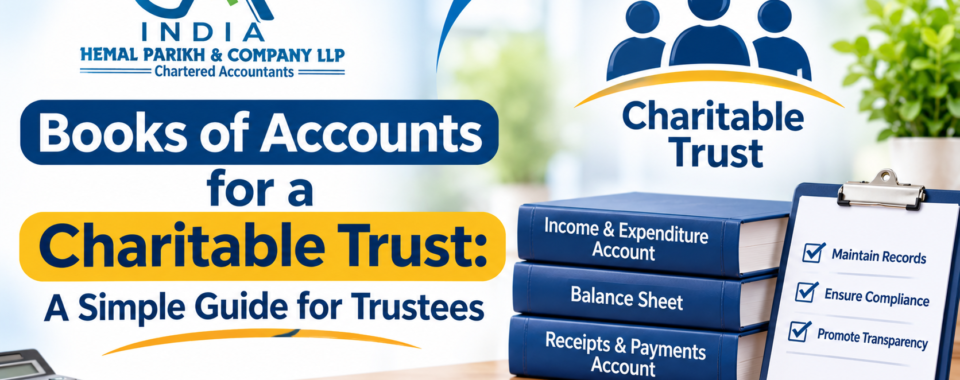
At year end, your accountant should prepare an income and expenditure account and a balance sheet. Maharashtra trusts file these in the formats prescribed under the Act (Schedules VIII and IX), and the accounts are generally required to be audited within six months of the financial year end. The audited accounts are then submitted online on the Charity Commissioner’s portal.
Good habits that save time
- Keep the trust’s bank account separate from personal accounts.
- Pay by cheque or bank transfer wherever possible, since cash payments create doubts.
- Reconcile the bank statement monthly to catch mistakes early.
- Back up your records and keep them safely for the years the law requires.
- Book a quarterly review with your CA, so year-end is not a rush.
Need help?
At CA, we help trusts set up clean books, prepare financial statements and complete trust audits on time. Reach out before the year-end rush, not during it.
Is it compulsory for a charitable trust to maintain books of accounts?
Yes. Every trustee of a public trust in Maharashtra must keep regular accounts.
Can I maintain trust accounts in Excel or Tally?
Yes. What matters is that entries are complete, dated and supported by vouchers.
Do small trusts need an audit?
Small trusts below a certain income may be exempt from audit under the Act, but they still file accounts. Check the current limit with your CA.
How long should I keep trust records?
Keep them for several years, since audits and queries can arise later. Your CA can confirm the exact period.
What is the difference between corpus and general donations?
Corpus is added to the trust’s permanent capital. General donations are used for day-to-day charitable work.