


The argument in favor of using filler text goes something like this: If you use real content in the Consulting Process, anytime you reach a review point you’ll end up reviewing and negotiating the content itself and not the design.
Contact Info
- Chicago 12, Melborne City, USA
- (111) 111-111-1111
- info@example.com
- Week Days: 09.00 to 18.00 Sunday: Closed
Social Links
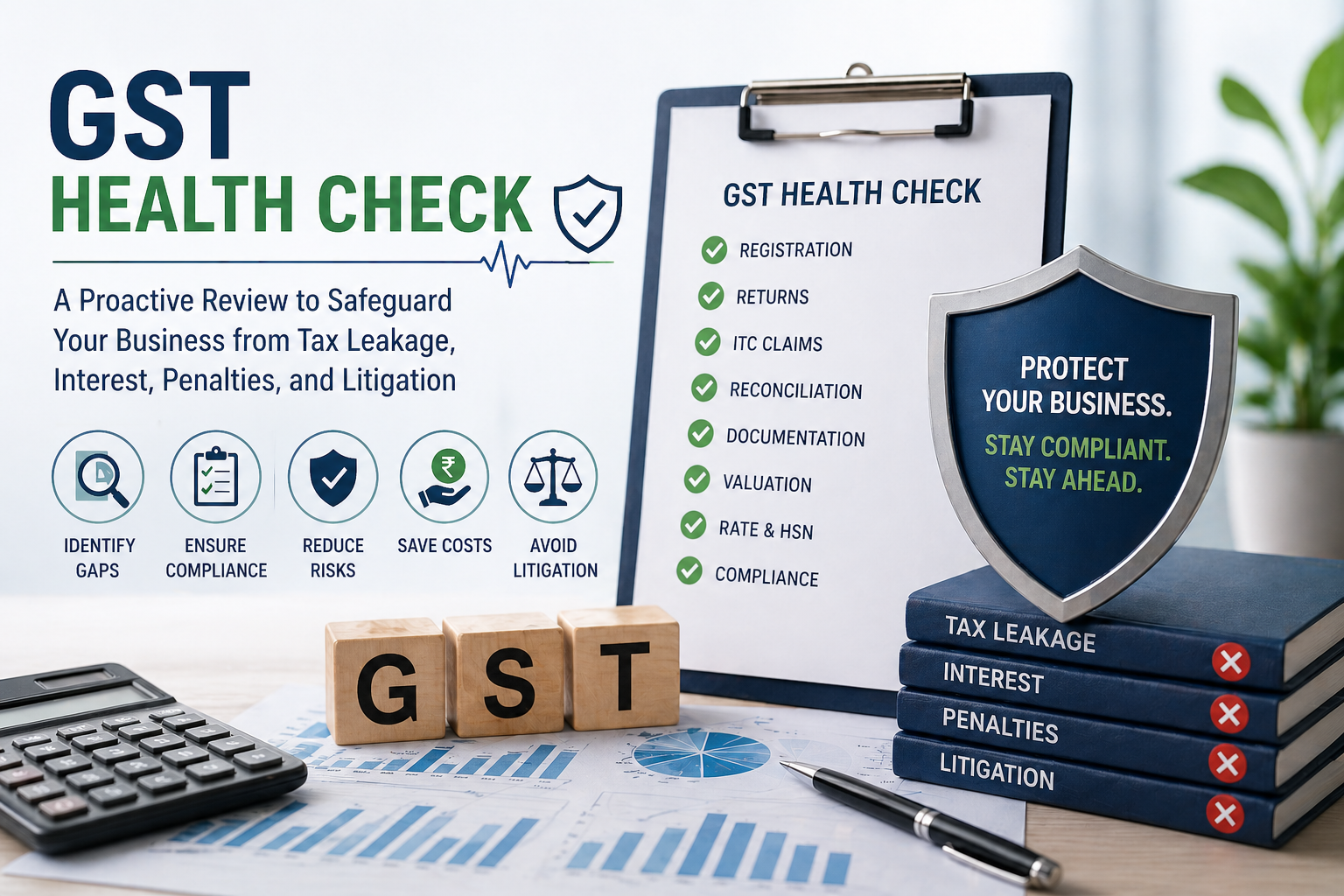
GST Health Check: A Proactive Review to Safeguard Your Business from Tax Leakage, Interest, Penalties, and LitigationHemal Parikh & Company LLP
GST compliance is no longer limited to filing returns on time. With increasing data-based scrutiny, notices, departmental audits, e-invoicing checks, and input tax credit mismatches, businesses are facing higher GST risks than ever before.
Even a small mistake in GST classification, invoicing, return filing, or ITC claim can result in heavy interest, penalties, blocked credits, and future litigation.
A GST Health Check is a proactive review process that helps businesses identify compliance gaps, tax leakage, ITC risks, and process weaknesses before they become serious legal or financial issues.
What is a GST Health Check?
A GST Health Check is a detailed diagnostic review of a business’s GST processes, returns, reconciliations, ITC claims, and compliance practices.
It helps businesses:
- Identify GST errors before authorities do
- Reduce risk of notices, penalties, and litigation
- Improve ITC utilisation and recovery
- Ensure proper return filing and reconciliation
- Detect process gaps in billing, procurement, and accounting
- Stay prepared for audits, due diligence, and departmental scrutiny
A GST Health Check works like a preventive medical check-up for your business compliance system. Instead of waiting for a GST notice or audit, businesses can proactively review and correct issues in advance.
Why is a GST Health Check Important?
Q1. Why should businesses conduct a GST Health Check?
Businesses should conduct a GST Health Check because GST laws are complex and continuously monitored through data analytics by tax authorities.
Common issues such as:
- Wrong GST rate application
- Incorrect place of supply determination
- ITC claimed without proper documentation
- GSTR-1 and GSTR-3B mismatches
- GSTR-2B reconciliation issues
- Missed reverse charge liability
- Errors in e-way bills and e-invoices
can lead to:
- Tax demands
- Interest liability
- Penalties
- ITC reversal
- Notices and litigation
A proactive GST review helps prevent these risks and strengthens the business’s overall compliance position.
Transaction and Process Review
Q2. What is covered under transaction and process review?
Transaction and process review focuses on examining the complete workflow from procurement to billing.
This includes:
- Review of purchase and sales transactions
- Verification of nature of supply
- Analysis of place of supply rules
- Review of valuation and tax rates
- Examination of related-party transactions
- Review of internal stock transfers and branch transactions
This review helps identify whether GST has been charged correctly and whether there are hidden tax risks in day-to-day operations.
Output Tax and Revenue Review
Q3. Why is output tax review important?
Output tax review ensures that GST charged on outward supplies is accurate and properly reported in returns.
The review includes:
- Invoice-wise verification of GST charged
- Review of taxable, exempt, and zero-rated supplies
- Verification of export and SEZ transactions
- Reconciliation between books of accounts, GSTR-1, and GSTR-3B
If outward supplies are reported incorrectly, businesses may face short-payment demands, notices, and penalty exposure.
Input Tax Credit (ITC) Health Check
Q4. What is an ITC Health Check?
An ITC Health Check is a review of whether the business is claiming the correct input tax credit under GST law.
It includes:
- Eligibility review under Sections 16 and 17
- Identification of blocked ITC under Section 17(5)
- Review of reverse charge mechanism credits
- Analysis of common credit reversals
- Identification of unclaimed ITC
- Review of ITC that may be disallowed during audit
Businesses often lose money because of unclaimed ITC or face notices due to incorrect ITC claims. An ITC Health Check helps optimise credit while reducing litigation risk.
GSTR-2B and ITC Reconciliation
Q5. Why is GSTR-2B reconciliation important?
GSTR-2B reconciliation is important because businesses can claim ITC only when the supplier has properly uploaded invoices.
A GST Health Check reviews:
- Reconciliation between books and GSTR-2B
- ITC claimed but not appearing in GSTR-2B
- Missing supplier invoices
- Prior period adjustments
- Mismatch between GSTR-2B and GSTR-3B handbook for committee members
Regular reconciliation helps prevent ITC reversals, departmental notices, and future tax demands.
Return Filing and Compliance Review
Q6. What does return filing review include?
Return filing review checks whether GST returns are filed accurately and within timelines.
It includes review of:
- GSTR-1
- GSTR-3B
- GSTR-9
- GSTR-9C
- Amendments and corrections
- Late fee and interest exposure
- Disclosure accuracy
Incorrect or delayed return filing can create significant compliance risks and increase the possibility of notices from GST authorities.
RCM, E-Invoicing and E-Way Bill Review
Q7. Why should businesses review RCM, e-invoicing, and e-way bills?
Many businesses receive GST notices due to non-compliance with reverse charge mechanism, e-invoicing rules, and e-way bill requirements.
A GST Health Check reviews:
- Applicability of reverse charge transactions
- Whether RCM liability has been discharged correctly
- E-invoicing compliance
- Invoice reporting errors
- E-way bill mismatches
- Risks in goods movement documentation
These areas are frequently checked by GST authorities and therefore require regular monitoring.
Refund, Export and LUT Review
Q8. Why is refund and export review necessary?
Businesses involved in exports often face delays in refunds due to incorrect documentation or LUT non-compliance.
A GST Health Check includes:
- Review of export transactions
- LUT verification
- Refund calculations and workings
- Verification of supporting documents
- Identification of refund blockage risks
This helps businesses improve cash flow and reduce delays in receiving refunds.
Litigation and Risk Exposure Assessment
Q9. How does a GST Health Check reduce litigation risk?
A GST Health Check identifies areas where the business may face future disputes, notices, audits, or assessments.
The review covers:
- Pending GST notices
- Previous audit observations
- Open assessments
- High-risk transactions
- Potential tax, interest, and penalty exposure
By identifying issues early, businesses can take corrective action before matters escalate into long-term litigation.
What Are the Key Deliverables of a GST Health Check?
Q10. What does a business receive after a GST Health Check?
After the review, businesses generally receive:
- Issue-wise risk report classified as high, medium, or low
- Quantified tax and ITC exposure analysis
- Detailed compliance gap analysis
- Practical corrective action plan
- Recommendations for improving GST processes and controls
These deliverables help management understand the exact compliance position of the business and the actions needed for improvement.
Who Should Opt for a GST Health Check?
Q11. Which businesses should consider a GST Health Check?
A GST Health Check is highly recommended for:
- Businesses facing GST notices or audits
- Companies with high ITC claims
- Export-oriented businesses
- Entities with related-party transactions
- Businesses planning mergers, acquisitions, or funding
- Companies preparing for statutory audit
- Businesses wanting stronger preventive compliance controls
These businesses usually have higher GST exposure and therefore benefit the most from periodic GST reviews.
Conclusion
GST compliance is no longer just about filing returns. It is about identifying hidden risks, preventing tax leakage, protecting ITC, and staying prepared for audits and notices.
A proactive GST Health Check helps businesses strengthen compliance, reduce financial exposure, and avoid unnecessary litigation.
Instead of reacting after receiving a notice, businesses should focus on preventive compliance today for stronger financial and legal protection tomorrow.
